
Digital Marketing for Real Estate in India: The 2026 Playbook
The complete 2026 playbook for digital marketing in Indian real estate: channel mix, launch-to-sold-out sequence, capture and speed-to-lead, and the metrics that matter.
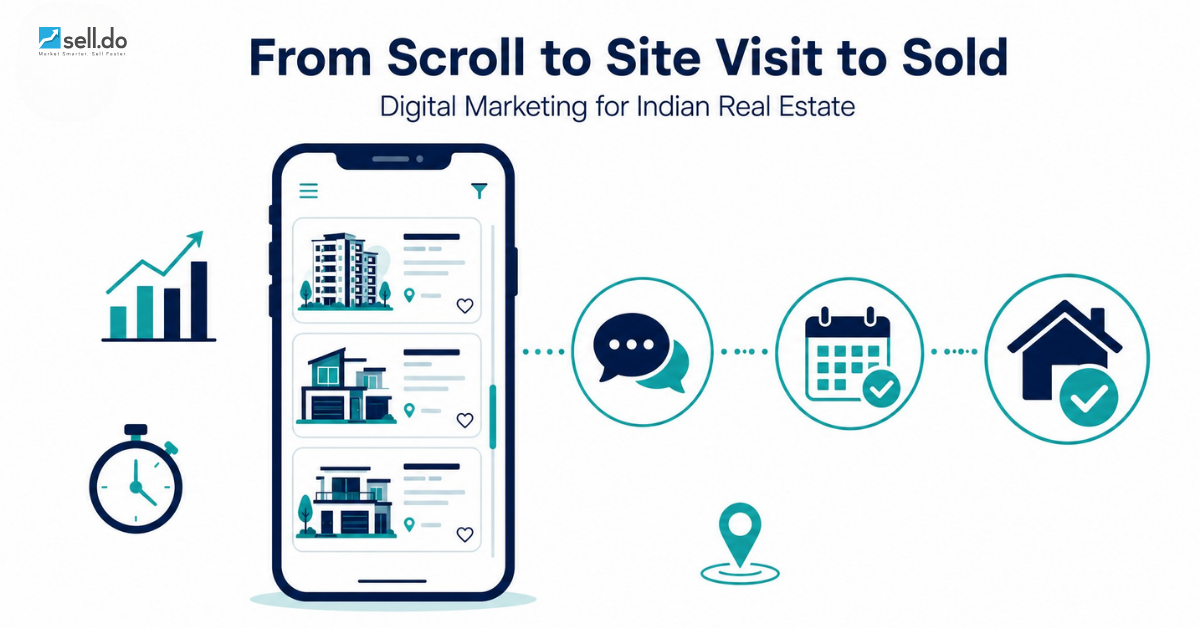
Ask a Pune or Bengaluru developer what their marketing costs today and you will rarely get a rupee figure per hoarding. You will get a cost per lead. Digital marketing for real estate in India has stopped being a channel line item and become the whole demand engine: the pre-launch waitlist, the site-visit calendar, and the attribution trail that tells you which campaign booked the flat. On Sell.do's own benchmark work, Meta leads for Indian residential projects land roughly in the Rs 150-2,000 band and Google search leads in the Rs 300-2,500 band depending on city tier and ticket size - and the gap between the top and bottom of those bands is almost entirely execution.
Yet most developer and broker marketing still runs blind. Leads land in three inboxes and a portal dashboard. Nobody tags the source. Presales calls the Meta lead four hours late. The MIS at month-end shows spend by platform but nobody can say which campaign produced the booking. That gap - not the ad platform - is where budgets die.
This is the pillar guide to digital marketing for real estate in India in 2026: the channel mix that actually produces site visits, the launch-to-sold-out sequence, the capture-and-speed-to-lead layer that decides whether spend converts, and the metrics that separate a marketing team from a media-buying team. Where a topic deserves its own deep dive - paid ads, WhatsApp, attribution - we link out to it. Start with the paid lead-generation playbook if budgets are your immediate problem.
Why Digital Decides Which Projects Sell Out in 2026
Indian homebuying now starts on a phone. Buyers shortlist on portals and Instagram, verify on YouTube walkthroughs and Google reviews, ask questions on WhatsApp, and only then agree to a site visit. By the time a buyer speaks to your sales team, most of the shortlist is already decided. Digital marketing is how you get into that shortlist - and how you stay in it during the eight to twenty weeks a typical Indian residential decision takes.
Three structural shifts make 2026 different from the playbook most teams are still running:
- Discovery moved to feeds and maps, not just portals. Portals still deliver volume, but the cheapest qualified enquiries increasingly come from Meta interest-and-behaviour targeting, Google Performance Max around locality intent, and organic short-form video. Portal-only demand generation now caps your funnel.
- Conversation moved to WhatsApp. An Indian buyer will answer a WhatsApp message they would never answer as a cold call from an unknown number. Click-to-WhatsApp ads and WhatsApp-first follow-up have quietly become the highest-converting entry point for most residential projects.
- Measurement moved from clicks to bookings. Platform-reported leads are a vanity number. The only figure that survives a management review is cost per booking by source, which requires the lead to be tagged at capture and traced all the way to the booking.
If your reporting stops at cost per lead, you are optimising the wrong number. Cost per lead vs cost per booking walks through why a Rs 300 lead source can be more expensive than a Rs 1,200 one.
From the team that built Sell.Do
See how Sell.Do runs your sales, pre-sales and marketing on one AI-first platform.
The India Real Estate Digital Marketing Stack (2026)
A working stack has four layers. Most teams over-invest in the first and neglect the other three, which is why spend rises while site visits stay flat.
Layer 1 - Demand generation
- Meta (Facebook and Instagram). Still the volume engine for residential. In 2026 the detailed-targeting cull means Advantage+ Audience plus strong creative outperforms hand-built interest stacks. Click-to-WhatsApp campaigns typically beat native lead forms on lead quality because the buyer self-selects into a conversation.
- Google Search and Performance Max. Highest intent, highest CPL. Reserve search for locality and project-name terms ('3 BHK in Wakad', '<project> price list') and let Performance Max handle discovery once you have enough conversion signal flowing back.
- Portals (99acres, MagicBricks, Housing). Reliable volume, weak exclusivity - the same buyer is talking to four projects. Treat portal leads as a speed-to-lead race, not a nurturing exercise.
- Organic search and content. Slow, compounding, and the only channel where your cost per lead falls over time. Locality guides, price-trend pages and project comparison content win here.
- Short-form video and creator collaborations. Reels and YouTube Shorts walkthroughs now do the job that a full-page newspaper ad used to, at a fraction of the cost and with retargetable audiences attached.
Layer 2 - Capture
Every channel above must drop into one place, tagged with source, campaign and creative. If a lead arrives by email, portal dashboard or a broker's WhatsApp and gets re-typed into a sheet, you have already lost the attribution and usually the response time as well.
Layer 3 - Response and nurture
First response in minutes, not hours. Automated WhatsApp acknowledgement on capture, a call attempt inside the first ten minutes, then a structured follow-up cadence until the site visit is booked or the lead is disqualified with a reason.
Layer 4 - Attribution and reporting
Source-to-booking reporting: spend, leads, qualified leads, site visits, bookings and revenue by campaign. Without this, the marketing budget conversation is opinion versus opinion.
Layers 2 to 4 are what a real estate CRM exists to do. Sell.do captures from Meta, Google, portals, your website, walk-ins and channel partners into one pipeline with the source tag intact, then handles calling, WhatsApp and the reporting on top. The mechanics of the follow-up cadence are covered in the lead management playbook.
Launch to Sold Out: The Campaign Sequence
Indian project marketing is not an always-on SaaS funnel. It is phased, and each phase has a different job, a different creative brief and a different acceptable CPL.
Phase 1 - Pre-launch (6 to 10 weeks out)
- Objective: build a tagged waitlist, not bookings. Optimise for cost per registered enquiry.
- Channels: Meta reach and lead campaigns, teaser Reels, locality SEO pages, broker and channel-partner activation.
- Creative: location advantage, developer credibility, RERA registration, 'pre-launch pricing' without over-promising.
- Trap to avoid: dumping pre-launch leads into a spreadsheet 'until we go live'. They go cold in a fortnight.
Phase 2 - Launch (weeks 1 to 4)
- Objective: convert the waitlist and add fresh demand. Optimise for cost per site visit.
- Channels: full Meta plus Google Search plus portals, retargeting the pre-launch audience aggressively, WhatsApp broadcast to the tagged waitlist.
- Operations matter more than media here: presales capacity, site-visit slot management and same-day follow-up decide the conversion rate.
Phase 3 - Sustenance (month 2 onward)
- Objective: steady booking velocity at a defensible cost per booking.
- Channels: shift budget toward the sources that produced bookings, not the ones that produced leads. Layer in organic content, referrals and channel-partner co-marketing.
- Re-engage the dormant pool - the six-month-old 'not now' lead is usually cheaper than a new one.
Phase 4 - Inventory-led push
- Objective: move slow inventory - specific towers, floors, or configurations.
- This only works when marketing can see live inventory. Running ads for a sold-out configuration is the fastest way to waste a month of budget and annoy buyers.
What Actually Works, Channel by Channel
Paid social: creative beats targeting now
With detailed targeting narrowed and signal loss from ATT, the lever that still moves CPL is creative and offer. Run four to six creative variants per ad set, refresh every two to three weeks, and feed conversions back to the platform so its model optimises against real outcomes rather than form fills. The targeting mechanics that still work are detailed in the Facebook ad targeting guide.
Google: buy intent, not impressions
Locality plus configuration plus budget queries convert; generic 'property in India' does not. Add negative keywords for rent, PG and jobs relentlessly - in Indian real estate accounts these routinely eat 20 to 30 percent of a raw search budget. Use call extensions: a meaningful share of Indian search enquiries prefer to dial.
SEO and content: the only channel with falling CPL
Target what buyers actually search: locality guides ('best areas to buy in Hinjewadi'), price and trend pages, RERA and documentation explainers, and honest project comparisons. One well-ranked locality page can outproduce a month of display spend, and it keeps producing after the campaign stops.
Video: the site visit before the site visit
Listings with video draw materially more enquiries than those without, and video pre-qualifies: a buyer who has watched a five-minute walkthrough arrives at the site with realistic expectations. You do not need a production house - a stabilised phone, decent light and a script beat an expensive drone reel with no story. Practical shooting notes are in our guide to shooting real estate videos.
Social organic: consistency over polish
Instagram and YouTube carry the weight for Indian residential. Construction-progress updates, handover moments, locality explainers and honest price commentary build the trust that ads cannot buy. LinkedIn matters for commercial and for channel-partner recruitment. Twitter and Pinterest, for most Indian developers, are a distraction.
WhatsApp: where the deal actually progresses
Click-to-WhatsApp ads, instant acknowledgement on capture, cost sheets and floor plans sent in-thread, site-visit reminders and post-visit follow-up. Opt-in and template rules apply - stay inside WhatsApp Business API policy and India's DLT norms for SMS. Ready-to-use message and script templates are here.
Retargeting and lead magnets
Most first-time visitors will not enquire. Retarget site visitors and video viewers with a specific next step - a price list, a floor-plan pack, a locality report, an EMI calculator - rather than the same brand creative they already ignored. Gate the asset behind a short form, then follow up on WhatsApp within minutes.
Reputation: the invisible conversion tax
Indian buyers check Google reviews and forums before a site visit. A pattern of unanswered complaints about possession delays or hidden charges will quietly halve your conversion rate, and no amount of media spend fixes it. Respond publicly, specifically and without defensiveness.
From Click to Booking: The Part Most Teams Skip
A campaign does not end at the lead form. Three operational habits move conversion more than any targeting change:
- Tag at capture. Source, campaign, ad set and creative should attach to the lead automatically. Retro-tagging from a spreadsheet at month-end is guesswork dressed as reporting.
- Respond in minutes. Speed-to-lead is the single highest-leverage metric in Indian real estate presales. A portal lead contacted in ten minutes and one contacted in four hours are not the same asset.
- Disqualify with a reason. 'Not interested' is useless. 'Budget below range', 'wanted possession-ready', 'different locality' - these codes are what let you tell Meta and Google what a good lead looks like, and what let you re-target the dormant pool intelligently later.
Sell.do runs this layer for developer and broker teams: unified capture with source tags, built-in calling and WhatsApp, TAT dashboards on first response, and AI-assisted qualification so presales spends its day on the leads worth calling. The full first-touch-to-booking sequence is in the lead management pillar.
The Metrics That Matter in 2026
Replace the platform dashboard with a single funnel view, by source and campaign:
- Cost per lead (CPL) - the entry metric, useful only alongside the ones below.
- Qualified lead rate - what share of leads meet budget, locality and timeline. A cheap source with a 5 percent qualification rate is expensive.
- First-response TAT - median minutes to first contact, tracked per team member. This is a management metric, not a marketing one, but it decides marketing ROI.
- Cost per site visit - the first metric that correlates properly with revenue.
- Cost per booking by source - the number to run the budget on.
- Dormant-pool conversion - bookings from leads older than 90 days. High performers get 15 to 25 percent of bookings here; teams without a nurture process get almost none.
What that reporting view looks like in practice - and which dashboards to build first - is covered in real estate CRM dashboards and analytics.
Five Mistakes That Waste Indian Real Estate Marketing Budgets
- Judging channels on CPL alone. The cheapest leads are frequently the least qualified. Judge on cost per site visit at minimum.
- Running the same creative for eight weeks. Meta creative fatigue in real estate sets in fast. Frequency climbs, CPL follows.
- Leads living in spreadsheets. Every export is a point where source tags, timestamps and follow-up history are lost.
- No channel-partner attribution. If broker-sourced leads are not tagged and tracked like digital ones, you cannot compare the two, and payout disputes become inevitable.
- Advertising inventory you cannot sell. Marketing and inventory must share one system, or you will spend real money generating demand for a sold-out configuration.
Where to Start
If you are rebuilding a real estate marketing function in 2026, the order matters. Fix capture and tagging first - it costs nothing in media and immediately makes every other decision measurable. Then fix speed-to-lead. Then optimise the channel mix against cost per site visit. Only after those three does creative and audience tuning give you the returns the case studies promise.
Sell.do is the AI-agentic CRM and marketing platform built for Indian real estate: unified lead capture across Meta, Google, portals, website, walk-ins and channel partners; built-in calling and WhatsApp; AI qualification and follow-up; live inventory; and source-to-booking attribution so you can see which rupee of spend produced which booking. See how it works, or book a walkthrough with your own funnel numbers in hand.
Related reading
Insights from the Sell.do real-estate CRM team.